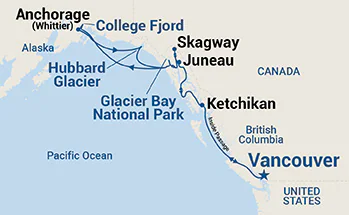
We boarded the Sapphire Princess in Vancouver in August 2023 for a 14-day round-trip Alaska cruise, one that does something most Alaska itineraries don’t: it hits both Glacier Bay National Park, College Fjord, and Hubbard Glacier, and it visits every major port twice, once heading north, once heading south. Most cruises out of Vancouver or Seattle run 7 days one-way and only get one of the two glacier destinations, if either, since Glacier Bay permits are limited and not every cruise line gets them. We picked this route on purpose: doing the loop both ways meant we could split our priorities and hedge our bets in case of bad weather. It also kept our flights simple, in and out of Vancouver, instead of an open-jaw itinerary into one city and out of another. Though we missed Denali in this trip, we’ll do it in the future.
It delivered more than we expected: close bear encounters, orcas and hundreds of humpbacks, a small-boat run right up to a calving glacier, some northern lights, and a stretch where we were both feeling pretty unwell in the last third. All of it is in here.
🎧 Prefer to listen? Press play for the audio version of this guide—then scroll down for all the details, maps, photos, and travel tips!
📌 This audio version was generated using AI for listener convenience and inspiration. It offers a high-level summary and does not include all the travel tips, photos, or full itinerary details. This feature is experimental and may contain minor inconsistencies compared to the written guide.
👉 For the most accurate and complete information, along with tips and packing essentials, be sure to read the full guide.
Table of Contents
Table of Contents
🛡️ Disclosure: This post may contain affiliate links. If you click through and make a purchase, we may earn a small commission at no extra cost to you. Thank you for supporting EpicScenic and helping uscreate more travel guides like this.
📍 Itinerary At a Glance
Day 1-2: Vancouver, Canada – Embarkation & At Sea
- Explore Vancouver International Airport’s Indigenous art collection, Stanley Park’s seawall and totem poles, and Gastown.
- Board the Sapphire Princess and settle in during a full day at sea.
- Meet the ship’s naturalist for a preview of wildlife to expect throughout the trip.
Day 3: Ketchikan (First Visit)
- Hike Settler’s Cove and the Rainbird Trail through Tongass National Forest.
- Walk Creek Street’s boardwalk over the water before the shops open.
- Watch salmon climb the Salmon Ladder and see the first humpback whales bubble-net feeding on departure.
Day 4: Juneau (First Visit)
- Hike to Nugget Falls and the Trail of Time at Mendenhall Glacier.
- Eat fresh king crab at Tracy’s King Crab Shack and visit the Red Dog Saloon.
- See Tahku, Juneau’s bronze breaching whale sculpture.
Day 5: Skagway (First Visit)
- Hike to Smuggler’s Cove, Yakutania Point, and the Dewey Forebay Dam trail.
- Explore Skagway’s Klondike Gold Rush-era downtown and boardwalks.
- Catch a first, faint glimpse of the northern lights departing port.
Day 6: Glacier Bay National Park (First Visit)
- Scenic cruising with a shipboard naturalist narrating wildlife sightings.
- Spot rafts of sea otters over a hundred strong, humpback whales, and dolphins off the ship’s bow.
- Take in glacier views from the ship’s forward deck.
Day 7: College Fjord
- Scenic cruising past glaciers named for East Coast colleges, including Harvard and Yale Glaciers.
- Watch and hear dramatic glacier calving up close.
Day 8: Whittier
- Walk to Cove Creek at Lu Young Public Beach and witness a black bear catch a salmon.
- Explore Begich Towers, the single building housing most of Whittier’s population.
- Take in views of Passage Canal from the ship’s top deck.
Day 9: Hubbard Glacier
- Scenic cruising alongside North America’s largest tidewater glacier.
- Book a small-boat excursion for a close-up view of the calving face and nearby sea lion haul-outs.
Day 10: Glacier Bay National Park (Second Visit)
- A second pass through the bay with even more otters, whales, and a first-ever mountain goat sighting.
- Crystal turquoise water and some of the trip’s best photo conditions.
Day 11: Skagway (Second Visit)
- Take the bear-viewing tour to Haines and the Chilkoot River Fish Weir.
- Watch a mother brown bear and two cubs fish and cross the road at close range.
- Catch a second, fainter glimpse of the northern lights.
Day 12: Juneau (Second Visit)
- A lower-key second stop spent wandering downtown Juneau.
- Spot a bald eagle resting on a treetop near the ship.
Day 13: Ketchikan (Second Visit)
- Walk downtown and along Ketchikan Creek to City Park.
- Find the same boardwalk seal and a black bear napping in a tree for hours.
Day 14-15: At Sea & Disembarkation
- A full day at sea used to rest and recover.
- Return to Vancouver for a final meal at Kingyo Izakaya before the flight home.
📌 Things to Keep in Mind for Future Travelers
🚢 Consider a Longer, Round-Trip Itinerary
Most Alaska cruises run a standard 7-day one-way route. We chose a longer round-trip itinerary that hit several ports twice, on the way north and again on the way south, and it paid off exactly the way we hoped. It gave us a second shot at bears in Ketchikan after striking out the first time in some spots, a second pass through Glacier Bay with even better sightings than the first, and enough built-in slack that a rough-weather day or a low-energy day didn’t cost us the whole trip. If you have the extra days, it’s worth strongly considering over the shorter version.
🥾 Explore Independently Where You Can, Book Excursions Where It Matters
We skipped most cruise line shore excursions and explored on foot or with a locally arranged rental car instead, which worked well in Ketchikan, Juneau, Skagway, and Whittier. But for Hubbard Glacier and the Haines bear-viewing day, we booked through the cruise line on purpose. At Hubbard, the small-boat excursion was the only way to get close to the calving face; the ship deck alone wouldn’t have cut it in the fog and rain we had that day. For Haines, going through the cruise line meant a guaranteed on-time return and reportedly priority ferry access if weather disrupted the crossing, both of which mattered more than the extra cost. Know which stops are worth doing on your own and which ones justify paying for the guarantee.
🐻 Wildlife Rewards an Early Start and a Naturalist
Nearly every wildlife sighting on this trip, the bears, the otters, the whales, happened either very early in the morning before towns woke up, or during the ship’s flagged wildlife windows in places like Glacier Bay. If your ship carries a naturalist, pay attention to their previews of where and when to be outside; ours gave us a heads-up a day or two ahead each time, and it made a real difference in not missing anything. Small-town ports like Ketchikan and Whittier are at their best before the shops open.
🌧️ Pack for Cold, Wet, and Long Stretches on Deck
Southeast Alaska is rainy and foggy far more often than not, Ketchikan alone averages over 140 inches of rain a year. Scenic cruising days like Glacier Bay and College Fjord mean standing at the front of the ship for hours, which drops your body temperature fast even on a day that doesn’t feel especially cold. Proper layers matter more here than almost anywhere else on this trip.
🚗 Rental Cars in Small Ports Need Advance Planning
In towns like Ketchikan, we arranged a rental car in advance through a local contact rather than trying to sort it out on arrival. In places like Haines, we found out rental logistics can be difficult on short notice, limited hours and unreliable phone response from agencies, especially outside peak season. If you’re planning to self-drive at a small port, lock it in before you arrive.
🩺 Sickness and Medical Situations Happen on Board
We spent the last third of this trip sick, which limited how much we could taste at meals and how energetically we explored the last couple of ports. Separately, on our very first night at sea, another passenger was evacuated by a Canadian Coast Guard helicopter after a fall, in the dark, without the ship stopping. Neither is meant to alarm, but both are a reminder that a cruise this long puts you somewhere remote for stretches at a time. Travel insurance that covers medical situations is worth having, and it’s worth pacing yourself early so a rough patch later doesn’t cost you the ports you care about most.
🧳 Packing Essentials for an Alaska Cruise
🧥 Clothing
Southeast Alaska in late August runs cool and wet more often than not, with scenic cruising days at the ship’s bow dropping your body temperature fast even when it doesn’t feel especially cold. Layering that can handle rain, fog, and long stretches outdoors matters more here than almost anywhere else on this trip.
🍎 Health & Protection Essentials
🦟 Bug Protection
Alaska’s summer mosquitoes are real, especially around Mendenhall’s streams and the Whittier trails. We treated our hiking clothes with Sawyer Permethrin Clothing & Gear Insect Repellent before the trip. One application lasts up to 6 washes or 6 weeks, and it made a real difference. This was our first time testing it, and we’ve used it on every trip since.
💊 Motion Sickness
We aren’t especially prone to motion sickness, and this trip was calm on that front, but some travelers are more sensitive to a ship’s motion. The only trip where we needed anything was our Antarctica cruise, and what worked well for us there was Non-Drowsy Bonine (Meclizine 25mg), worth packing just in case.
📷 Camera Gear
We used the Sony Alpha a6600 Mirrorless Camera paired with a Tamron 18-300mm F/3.5-6.3 Di III-A VC VXD Lens, which delivered just fine for this trip and held up well through the rain and fog we ran into at nearly every port. Looking back, though, we would have done better with an upgrade we didn’t make until a couple of years later: the Sony FE 200–600mm F5.6–6.3 G OSS Lens, for real reach on wildlife and glacier calving from a distance.
🐻 WILDLIFE WE ACTUALLY SAW
This trip delivered wildlife at nearly every stop, some expected, some a total surprise.
Ketchikan: A seal swimming between the shops on the boardwalk over the water on our first morning there, before the shops opened. Salmon climbing the stream by the boardwalk on both visits. On our second Ketchikan stop, a black bear asleep in a tree above that same boardwalk area, still there four or five hours later when we passed by again, occasionally shifting position and even yawning for the camera.
Juneau (Mendenhall Glacier): Signs of bear activity along the trail, though no bears themselves. Salmon spawning in the streams near the glacier, a theme that repeated at nearly every port.
Skagway: Salmon in the stream on our hillside hike, along with squirrels and what we believe were bear claw marks on some tree trunks.
Glacier Bay National Park (both passes): Large rafts of sea otters, floating together in groups that resembled little mummies bobbing on the water, some holding hands, numbering well over a hundred across multiple sightings. Orcas. Dozens of humpback whales over the two days combined, some bubble-net feeding right near the ship. On our second pass, a mountain goat on the cliffs (our first ever) plus more otters and seals resting on small chunks of ice calved off the glaciers. Dolphins followed the ship on our way to dinner one evening, visible jumping through the restaurant windows.
Whittier: A black bear catching a salmon in the stream at Cove Creek, close enough for a clean shot before it bolted with the fish. A bald eagle downtown. The town itself was covered in bear scat, a good sign of how often bears pass through.
Hubbard Glacier: Sea lions in large numbers on the rocks near the glacier’s front, males, females, and juveniles together.
Haines (Chilkoot River, via the Skagway bear-viewing tour): A mother brown bear with two cubs fishing at the Chilkoot River Fish Weir, the salmon-counting structure used by Alaska Department of Fish and Game to track the run upstream. We watched them for a long stretch, cubs standing on their hind legs to watch the bus approach, the mother actively helping them catch fish, and at one point the family crossed the road right in front of us. Bald eagles at a stopover later in the tour.
A note on the salmon themselves: Alaska has five species of Pacific salmon, and locals have a useful trick for remembering them, using your own hand. Thumb rhymes with chum. Point your index finger at your eye, and that’s sockeye. Your middle finger is the biggest on your hand, and king (chinook) is the biggest salmon. Silver rings are worn on the ring finger, and silver (coho) is next. And your pinky is small, easy to remember for pink (humpy), the smallest of the five. Most Alaskan kids learn this in kindergarten. For what it’s worth, king salmon is generally considered the richest and most prized for eating, highest fat content, while pink salmon is the mildest and most commonly canned.
❄️ NORTHERN LIGHTS: TWO FAINT SHOWINGS
We saw the northern lights twice on this trip, once departing Skagway the first time, once departing Skagway the second time (fainter than the first). Neither time were they dramatic to the naked eye; with the cruise ship’s ambient light, all we could really make out was a whitish cast across the sky. Through the camera, though, you could pick up the green tones overhead. This was our first time ever seeing the aurora, understated as it was. We’d go on to see a spectacular display later, on our Iceland trip, but there was something nice about this being the first.
🗺️ Day-by-Day Itinerary
DAY 1–2: Vancouver – Embarkation & a City Warm-Up
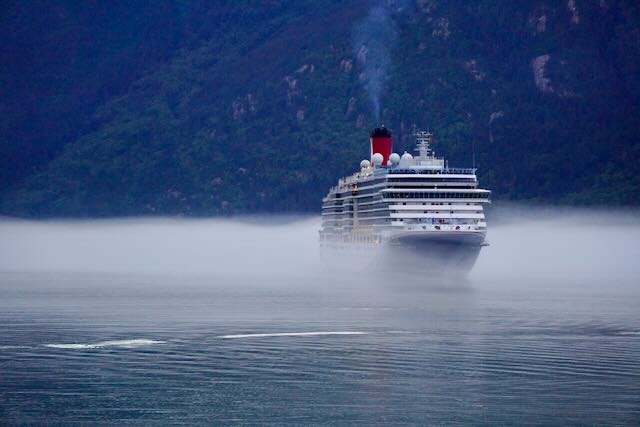
Even before we got to the hotel, Vancouver International Airport (YVR) was worth paying attention to. The terminal houses the largest collection of Northwest Coast Indigenous art of any airport in the world, including Bill Reid’s bronze sculpture The Spirit of Haida Gwaii: The Jade Canoe (which also appears on the Canadian $20 bill) and a Musqueam welcome area with a carved welcome pole. If you land with even twenty minutes to spare (or maybe on departure day), it’s worth slowing down to look at it rather than beelining for the exit.
We landed at 11:15 AM and were out of the airport by around 12:15 PM. From there, we took the Canada Line (SkyTrain) into the city, about a 30-minute ride, both stations within Zone 1.
We stayed at the Exchange Hotel Vancouver, An Executive Hotel, downtown near the cruise pier and the harbor where the seaplanes take off and land. It was very clean and quiet inside, walking distance to several downtown attractions, though the immediate pier area itself was a bit noisy with the near-constant sound of small planes taking off and landing. Worth knowing if you’re picking a hotel for peace and quiet versus convenience; we’d still choose the location again for how easy it made getting to the ship. Just a block away is Breka Bakery & Café, a great spot for coffee and pastries, easy to duck into before a full day of walking.
By early afternoon we’d checked in and started exploring. Still tired from the travel day, we kept it simple: Stanley Park, walking the seawall, the Shakespeare Garden, and the totem poles inside the park. It was beautiful, full of flowers, and we even watched a raccoon working over a trash can, presumably fueling up before winter. From there we walked through Gastown, past the steam clock and up and down the main commercial street.
The next morning, with boarding not until noon, we had time to explore Gastown further before heading to the pier. We boarded the Sapphire Princess at noon on August 23, with the ship departing port at 4:30 PM.
Boarding a cruise ship never stops feeling like a moment, imposing, enormous, full of everything waiting for you inside. Embarkation day included the standard onboarding: a muster station drill where you watch the safety video and learn exactly where to go in an emergency, mandatory but quick. We took the rest of the day easy, settling into the cabin, finding our way around the ship, and resting after a long travel day.
Day 2 was a full day at sea, and this is when the ship’s naturalist was introduced, someone who’d be aboard the entire trip. We were excited after that introduction, since they gave us a preview of where and when we’d likely see different wildlife over the coming days. The previous night had an unexpected turn: a guest apparently fell and hit their head, and while the ship was navigating in the dark, a Canadian Coast Guard helicopter came to evacuate them to a hospital on shore, without the ship stopping. Passengers were asked to stay off the deck during the operation. Everything else stayed on schedule, and the sea day itself offered some nice coastal views as we sailed north.
DAY 3: Ketchikan (First Visit) – Totems, Rainforest, and First Whales
In port 6:00 AM – 2:00 PM
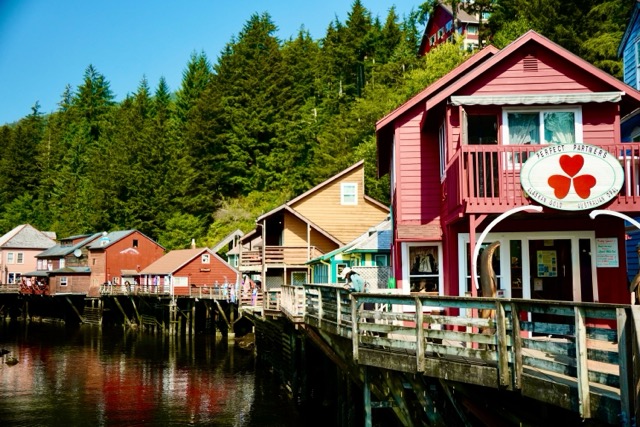
Ketchikan calls itself the Salmon Capital of the World, and the numbers back it up: five species of Pacific salmon run through Southeast Alaska’s waters here, and the fishing and canning industry built the town long before cruise ships found it. It also holds the largest collection of standing totem poles anywhere, with Tlingit, Haida, and Tsimshian carvers using the town as a cultural center for well over a century. Creek Street, the old red-light district built on pilings above Ketchikan Creek, is the most photographed leftover from that era. The setting explains the rest: Ketchikan sits in the Tongass National Forest, the largest temperate rainforest in the world, which is why the town gets over 140 inches of rain a year and why everything around it is so relentlessly green.
Arrival was early. Even before disembarking, it was a striking first look at the town from the upper deck. Like most of coastal Alaska, it isn’t connected to the rest of the state by road; instead, it is just one road going a few miles north and south from Ketchickan. While we waited for the ship to properly dock and allow us to get out, we had a hearty breakfast before the intense day ahead.
Since we arrived at the port earlier than we’d told our rental car contact, we used the extra time for a fast walk through the boardwalk shopping area (Creek Street) over the water. Everything was still closed that early, but the walk paid off anyway, since we could take pictures without photobombs and everything was quiet and peaceful.
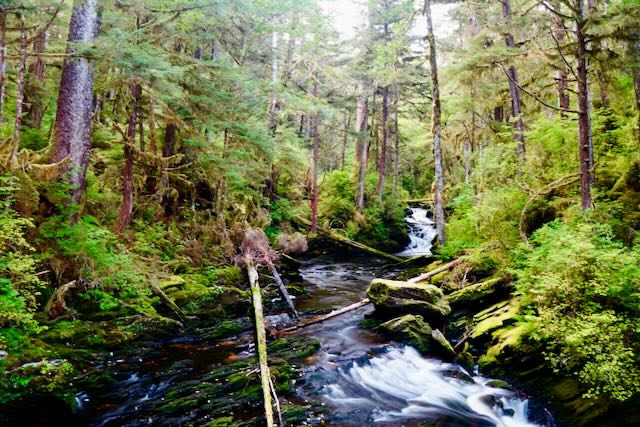
Back at the pier, we picked up the car and drove north to Settler’s Cove for a hike through the woods. We’d hoped for bears and didn’t see any, but the hike itself through the dense forest and wooden bridges crossing streams was worth it regardless. The drive from the port is about 30 minutes, and we spent about an hour and a half up there. All in all, we were back in town around 9:30AM, where we decided to take another hike. Just behind the University of Alaska, South Ketchikan Campus, there was a trail we decided to take (Rainbird Hiking Trail)
From there we drove south past the pier to Rotary Beach, a small park beach covered in seaweed, where we found a jellyfish washed up on shore. Not a huge amount to see here, but a nice quick stop. We decided to go because we saw some people finding starfish on the coast but we didn’t find a single one, just the jellyfish.
By early afternoon, we returned to the boardwalk shopping area, now open and full of life. Something we noticed in the early morning, but was a bit worse now with the afternoon sun, were rotting (smelly) fish carcasses on some of the rocks, evidence of what the bears (and eagles) come for. We watched salmon trying to climb the stream through the Salmon Ladder, walked the length of it, and ducked into a few shops. Just in front of the port there’s a second cluster of shops catering to cruise passengers; a few stood out, one in particular had an impressive selection of mineral rocks and fossils, and there was a fair amount of jewelries and gold-themed merchandise, a nod to Alaska’s mining history. This area also offers lumberjack shows, which we skipped to have more time to spend exploring town and hiking.
We deliberately skipped the Potlatch Totem Park and Museum and the Saxman Totem Park, as we had seen totems before and didn’t want to spend time here, but it seems that at least one of them may be worth it to some people who had never seen totems before.
Just before departure, as the ship pulled away from Ketchikan, we saw our first humpback whales bubble-net feeding, breaching the surface as a group. It wouldn’t be the last time we’d see that behavior on this trip.
DAY 4: Juneau (First Visit) – Glaciers, King Crab, and Gold Rush History
In port 8:00 AM – 9:00 PM
Juneau is the only state capital in the US you can’t reach by road. Boats and planes are it, boxed in by the Gastineau Channel on one side and the Coast Mountains and Juneau Icefield on the other. The town got its start in 1880 when Joe Juneau and Richard Harris, guided by Tlingit leader Kowee, found gold in the creek that now runs through downtown, and the mining money built the place before politics did; it became the territorial capital in 1906. What makes Juneau different from other Alaska port stops is what’s sitting right behind it: the Juneau Icefield, a roughly 1,500-square-mile mass feeding nearly forty glaciers, including Mendenhall, which you can walk to from a city bus stop. Whales, bears, and eagles show up around town without much effort, which is rare for a state capital anywhere.
Got our hearty breakfast while the ship was arriving in port, and immediately got outside as soon as they opened the doors. We found a taxi in downtown Juneau very early, right after arriving. It was foggy, chilly, and wet. The taxi dropped us right at the entrance to Mendenhall Glacier, where we’d already booked our tickets in advance, so we just had to show them at the gate.
Our first stop inside was the trail to the base of Nugget Falls, a big, striking waterfall with the glacier visible from its base. Along the way you’ll walk along the Mendenhall Lake, with icebergs floating in it. The trail is well marked with bear safety information. There are also small marker signs along the route showing where the glacier’s edge used to sit years ago, a sobering (and sad) way to see how fast it’s retreating. One at the bottom of the waterfall, photos of it without other people in the background take some patience since everyone’s trying to get the same shot, but the views are worth the wait. On a clear day you can see the glacier from the falls and, at least during our trip, we didn’t have anyone blocking the view.
Some visitors kayak here; we opted to hike instead. After Nugget Falls, we visited the visitor center (a more distant but still solid view of the glacier, plus historical context on the area), then did another hike around the Trail of Time and the junction near the Moraine Trailhead before heading back toward town.
One more thing worth noting about Mendenhall: the streams there, like at nearly every port on this trip, were full of salmon spawning upstream, which is also what draws the bears, even though we didn’t see any there ourselves.
Downtown had been nearly dead when we arrived that early, so we were hoping for more life on the way back. On the return, the same taxi that dropped us off happened to be heading back down with other passengers; it was a van, and they were happy to have us join and split the fare with the group headed back to Juneau.
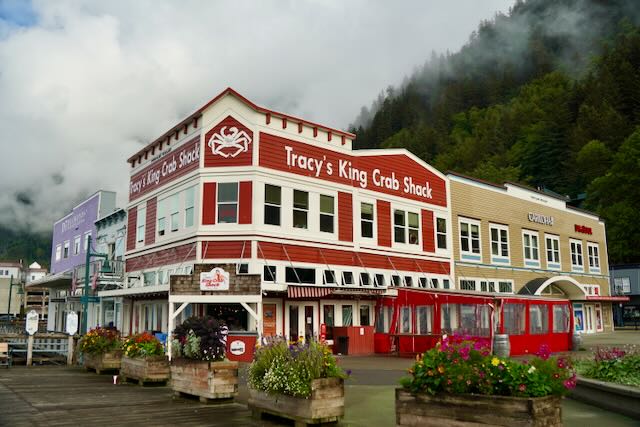
We checked out two well-known spots downtown. Tracy’s King Crab Shack, right on the docks, started in 2006 as a single crab pot and a hot dog cart before growing into the Juneau institution it is today, fresh Alaskan king crab. The Red Dog Saloon is the older of the two by decades: it traces back to Juneau’s mining era, was officially licensed in 1933 right after Prohibition ended, and has since become known for its gold rush memorabilia and floor covered in several inches of sawdust, a detail that’s become as much a part of its identity as the drinks.
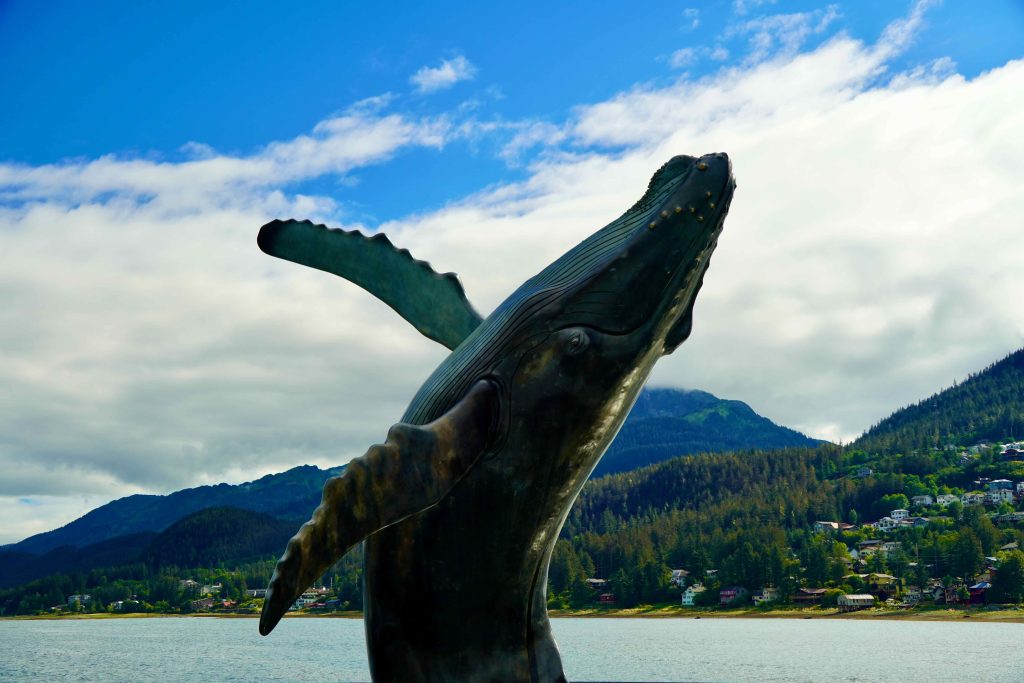
From there we walked out to Tahku, Juneau’s breaching humpback whale sculpture (also known as the Whale Project), a six-ton bronze whale rising out of an infinity pool on the Gastineau Channel waterfront. It was created by Alaskan sculptor Skip Wallen and unveiled in 2016, the result of an idea two former Juneau mayors had been pushing for years. It’s a striking piece, worth the walk even if you’ve already seen your fill of wildlife that day.
DAY 5: Skagway (First Visit) – Gold Rush Trails and a First Brush with the Aurora
In port 6:00 AM – 8:30 PM
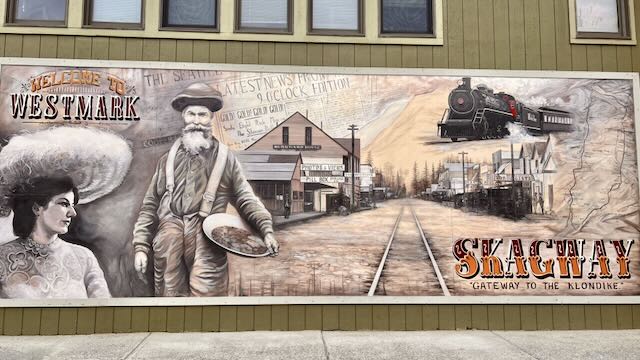
Skagway’s whole identity traces back to the Klondike Gold Rush, when it served as the main gateway for prospectors heading north over the mountains to the goldfields. Some of the signage around town gets into the harder history too, including the wreck of the Princess Sophia in October 1918. She left Skagway late in the season, overloaded with passengers trying to beat the winter ice, and ran aground on Vanderbilt Reef in a blinding snowstorm on the way to Juneau. Rescue ships couldn’t reach her in time before she slipped off the reef in worsening weather; all 343 people aboard died, the only survivor was a dog. It remains the deadliest maritime disaster in Alaska’s history, and largely forgotten outside the region, likely because it happened the same week as the armistice ending World War I.
Once again, we got an early start and had the trails largely to ourselves. First stop was a walk to Smuggler’s Cove and Yakutania Point, just outside town, quiet and foggy with nice water views along the coast.
From there, before the town itself was awake, we hiked up the Dewey Forebay Dam trail on the hillside above Skagway for views looking down over the town, plus lake and mountain views. Along the way we spotted salmon in the stream, squirrels, several types of mushrooms we hadn’t seen before, and what we believe were bear claw marks on some tree trunks. Snow-capped peaks framed the views from up top.
Back in town by mid-morning, Skagway was in full swing; touristy in a charming way, plenty of jewelry shops and bars, with wooden boardwalks in front of the storefronts standing in for sidewalks, a deliberate nod to the town’s gold rush-era feel that’s well done. There’s a preserved rotary snowplow train sitting in town like a static museum piece, historically used to clear snow from the tracks in winter. Skagway’s whole identity traces back to the Klondike Gold Rush, when it served as a gateway for prospectors heading north to the goldfields; some of the signage around town covers this history, including grim chapters like the fatalities among prospectors who left too late in the season and were caught by weather.
We also noted the White Pass & Yukon Route train, which runs from Skagway up over the pass into Canada; we didn’t ride it because we want to have the time to explore town and hike the trails, but it’s a well-regarded option for anyone who wants to add it.
That night, departing Skagway, we caught our first ever glimpse of the northern lights. It was faint, more of a whitish cast to the naked eye given the ship’s ambient light, but with visible green tones through the camera.
DAY 6: Glacier Bay National Park (First Visit) – Otters, Whales, and a Living Timeline
Scenic cruising, 6:00 AM – 3:00 PM
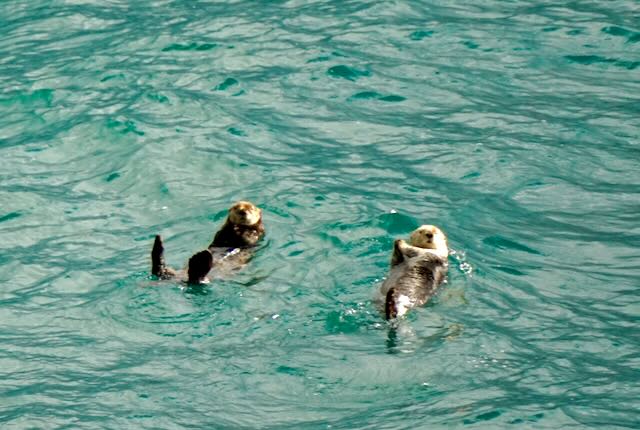
Two hundred fifty years ago, Glacier Bay didn’t exist as a bay at all; it was a solid wall of ice, part of a glacier over 4,000 feet thick and up to 20 miles wide, according to accounts recorded when George Vancouver charted the coastline in 1794. Since then it’s undergone the fastest documented glacial retreat on record, the ice pulling back more than 65 miles and opening up the bay as we see it now. That retreat created a live timeline: as you travel up the bay today, you’re moving backward through roughly 250 years of ecological succession, from mature forest near the mouth to bare rock and pioneering plants near the tidewater glaciers still calving at the head. It’s a UNESCO World Heritage Site now, and the Huna Tlingit, whose ancestors were displaced by the advancing ice centuries ago, still consider it homeland.
One of the best features of this particular cruise, and part of why we chose it, is that Princess Sapphire brings a naturalist aboard. In addition, this ship allows passengers up to the very front of deck 7, letting you scan both sides of the ship for wildlife as you cruise deeper into the bay. The naturalist gives talks throughout the day and typically previews, a day or two ahead, what to expect and when, so you know when to be outside and watching.
We were up early, had a fast breakfast, and got outside for the day. Glacier Bay did not disappoint on wildlife: large rafts of sea otters (some of them floating together in groups that looked like little mummies bobbing on the surface), orcas (we missed them), and a large number of humpback whales, some bubble-net feeding, all of it close to the ship. We lost count of the otters somewhere well past a hundred, seen across multiple points as we moved through the bay.
The glacier views themselves were amazing, even without the calving theatrics we’d get a day later at College Fjord. Standing at the front of a moving ship for hours drops your body temperature fast, even on a day that isn’t especially cold, so proper layers matter here more than almost anywhere else on the trip.
We were out at the front of the ship, on deck 7, from around 6:30 AM until roughly 6:00 PM, since the naturalist flagged multiple wildlife windows throughout the day and we didn’t want to miss any of it. Princess does a good job supporting this: alongside the naturalist’s narration, crew provided hot cocoa, hot tea, and warm noodles throughout the day to help everyone stay warm.
The last surprise of the day came at dinner. On the way out of the dining room, through the restaurant windows, we watched dolphins following the ship and jumping alongside it, right next to the tables. A great way to close out the day.
DAY 7: College Fjord – Ivy League Glaciers and the Loudest Calving Yet
Scenic cruising, 6:00 PM – 8:30 PM
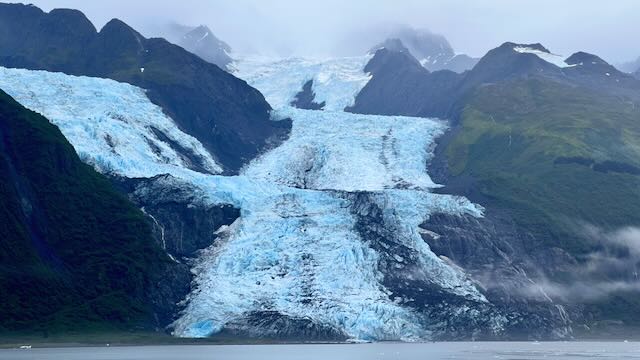
College Fjord is one of the odder naming stories in Alaska. It was mapped in 1899 during the Harriman Expedition, whose scientific team included professors from Harvard and Amherst, and they had some fun with it: nearly every glacier here is named after an elite East Coast college, women’s colleges lining one side of the fjord, men’s colleges on the other. You can pick out Harvard Glacier and Yale Glacier, the two largest tidewater glaciers in the fjord, along with Vassar, Smith, Bryn Mawr, Amherst, and Barnard.
This was the day the calving really delivered (before Hubbard). We heard it before we fully processed what we were hearing, a deep crack building into a roar, then a section of ice breaking away and crashing into the water below, sending waves rippling out across the fjord. We caught it on camera more than once. Between the glacier names being a fun bit of trivia and the calving being some of the most dramatic we saw on the whole trip, this ended up being one of our favorite scenic-cruising days of the cruise.
DAY 8: Whittier – Bears, Glaciers, and a Town in One Building
In port 12:30 AM – 8:30 PM
Whittier is a strange one even by Alaska standards. The US Army built it during World War II as a secret, ice-free port, choosing the location specifically because it’s socked in by clouds most of the year, which made it hard for enemy aircraft to spot. Nearly the entire population lives in a single building, Begich Towers, a former Army barracks converted to condos. The only land access is the Anton Anderson Memorial Tunnel, at 2.5 miles the longest combined rail and highway tunnel in North America, and it’s one-lane, alternating direction on a timed schedule. Whittier sits at the head of Passage Canal in Prince William Sound, which makes it the jumping-off point for glacier cruises into the sound, including toward Blackstone Bay and Columbia Glacier.
Arrival was very early, just after midnight, which worked in our favor for wildlife. Whittier itself was quiet, still early in the morning and past peak season by late August, shops closed. We stepped out as soon as we finished breakfast by 7 AM. One thing that stood out immediately: the whole (small) town was covered in bear scat, a clear sign of how often bears pass through.
We walked from the cruise terminal to Cove Creek at Lu Young Public Beach, drawn by reports of bear sightings along the stream that empties into the sea there. We spent a good amount of time walking up and down the creek, rainy, foggy, humid conditions, without seeing anything. Just as we were ready to head back, a black bear appeared and caught a salmon right in the stream. It was closer than we expected; we froze, got the camera up, and it grabbed the fish and bolted in the other direction. We got a couple of good shots. It was our first close bear encounter, ever.
Back in town around 10 AM, we spotted a bald eagle and noted the one large building that seems to house most of Whittier’s residents along with the school and post office. That single building is Begich Towers, a 14-story tower originally built in 1957 as Cold War-era military housing, and today home to the overwhelming majority of Whittier’s roughly 200 to 300 residents. It’s effectively a vertical town: the building holds a convenience store, a health clinic, a laundromat, and even a church, all under one roof, largely a practical response to Whittier’s isolation and brutal winters (it’s only reachable by a single tunnel or by boat). It’s been the subject of a few documentaries and news features over the years, CBS Sunday Morning and NPR among them, for exactly that reason: it’s one of the only places in the country where nearly an entire town shares one address.
Around 10:00 AM, most shops were still closed, and most of the activity we saw was other passengers, many heading onward to Denali or flying home from here rather than doing a simple day trip, since this cruise combined the up-and-down route specifically so travelers could continue overland from Whittier if they chose to. We considered taking a day trip to Anchorage to see the town and possibly spotting moose, but the trip is long and the logistics are a bit challenging to make it back in time before departure, so we skipped it this time.
We decided against booking any additional glacier tours here, since between Glacier Bay and everything we’d see later from the ship, we didn’t feel we needed another one, and we preferred the freedom to explore on our own and fit in smaller hikes if we wanted to. Between the adrenaline of the bear encounter early on and the quieter exploring after, it made for an intense but satisfying day. The coastal views from shore were quite good even without a formal excursion. We were back on the ship by noon to a good lunch and to take some nice pictures of the Passage Canal from the top deck.
DAY 9: Hubbard Glacier – A Small Boat, Big Ice, and Champagne in the Rain
Scenic cruising, 3:00 PM – 8:00 PM
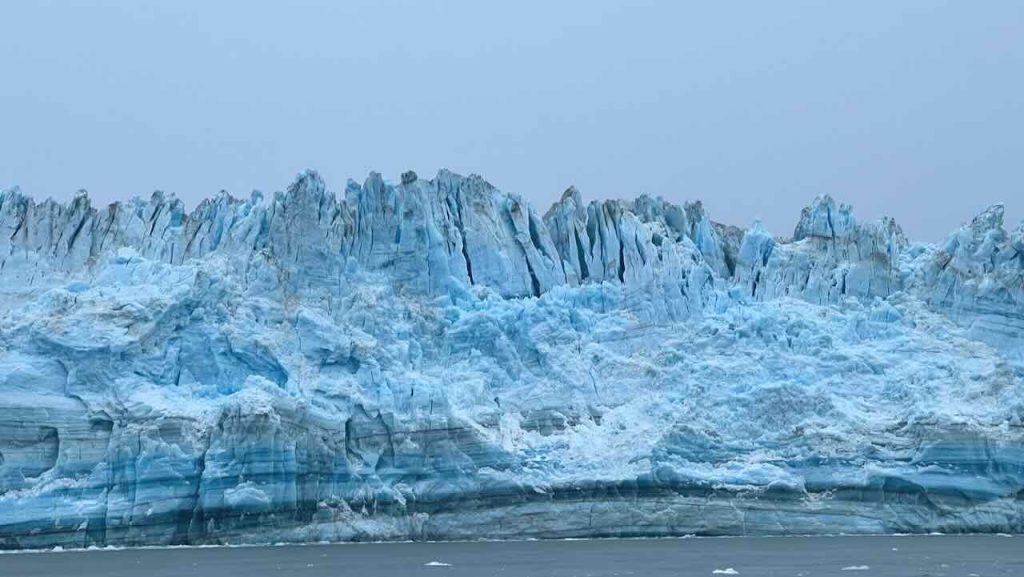
Hubbard is the largest tidewater glacier on the North American continent, stretching about 76 miles from its source on Mount Logan in Canada’s Yukon down to Yakutat Bay in Alaska, with a calving face over 6 miles wide. What sets Hubbard apart from most glaciers in the state is that it’s advancing, not retreating, one of the few in Alaska still gaining ground. It has surged forward enough times to seal off the entrance to Russell Fjord and turn it into a lake, most notably in 1986 and again in 2002, trapping marine mammals inside until the ice dam broke. The calving here is loud and constant, with chunks of ice the size of buildings dropping into the bay, making it one of the more reliably dramatic glacier stops on the route.
At Hubbard, you essentially have two options: stay on the ship and hope for clear enough weather to see the glacier from the deck, or book the small-boat excursion that takes you much closer to the glacier’s face. We don’t typically book cruise line tours, but this was an exception, since we wanted a guaranteed close-up view rather than gambling on visibility from the ship. It was foggy and rainy that day, so nothing would have been visible from the ship anyway; we were glad we’d booked the boat.
On the way out, we passed large numbers of sea lions hauled out on the rocks along the shore, males, females, and juveniles together. It was cold and wet, but the boat got close to the glacier’s face, close enough that at points we were surrounded by floating chunks of ice, like ice cubes in a drink. The boat maneuvered for different angles while staying at a safe distance, and we watched (and heard) repeated calving, huge sections of ice breaking away and crashing into the water, sending out big waves.
This was also the day one of us started feeling under the weather, so the experience wasn’t quite 100% what it could have been. Even so, looking back at the photos and videos, it was absolutely worth it. Once we got back aboard from the small boat, crew were waiting with a small glass of champagne; a nice touch after being out in the cold rain.
DAY 10: Glacier Bay National Park (Second Visit) – A Mountain Goat and Turquoise Water
Scenic cruising, 9:15 AM – 7:30 PM
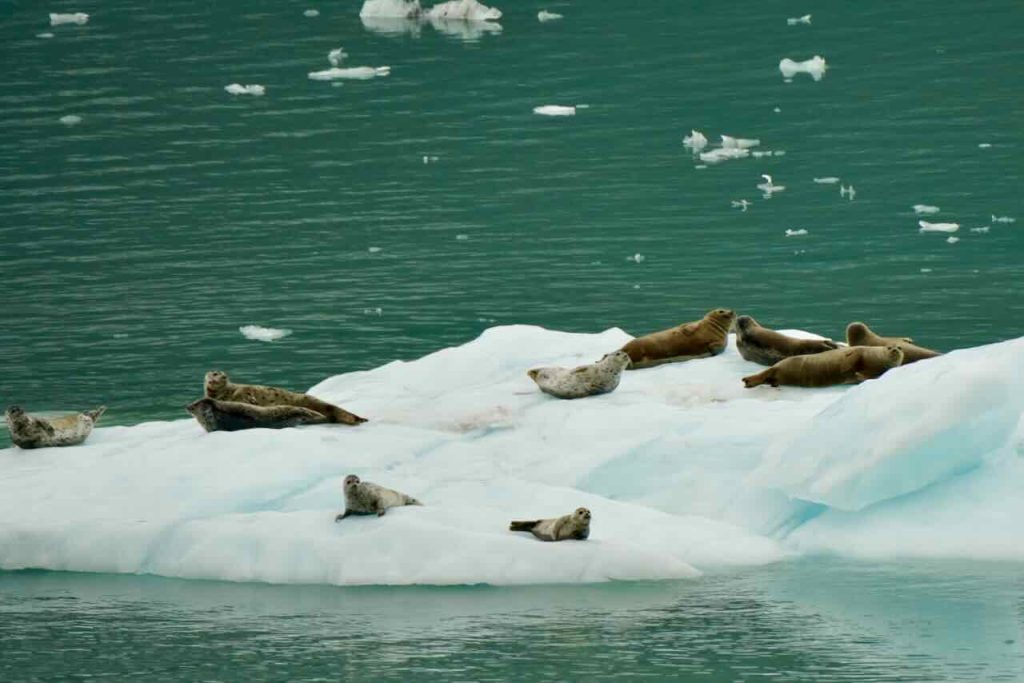
Our second pass through Glacier Bay turned out even better than the first in some ways. We again saw large numbers of humpback whales and otters (still in the hundreds), plus glacier views. The highlight of this second day was our first-ever mountain goat sighting, spotted on the mountainside at a distance, but an exciting surprise.
We again saw large groups of otters floating together, some visibly holding hands or paws, plus, new for this second pass, a good number of seals resting on smaller floating chunks of ice near the ship. The lighting this day was beautiful, and the water took on a crystal blue-turquoise color that made for some of the best photos of the trip. Humpback activity was especially close to the ship this time, with repeated surfacing and blows visible right off the bow.
DAY 11: Skagway (Second Visit) – Grizzly Cubs at the Chilkoot Weir
In port 7:00 AM – 8:30 PM
This was the day we’d specifically saved for the bear-viewing tour to Haines, since it was the only reliable way to see coastal brown bears (as they’re called locally, the larger coastal cousin of the inland grizzly) in a controlled, safe way, and booking it through the cruise line meant a guarantee we’d be back aboard on time.
We were nervous that morning because winds were reportedly strong enough that the ferry between Skagway and Haines might not run at all. It ended up working out. Once in Haines, a bus (basically a school bus with windows that open for photos) took us north along the Lutak Road to the Chilkoot River Fish Weir, the metal salmon-counting structure used by Alaska Department of Fish and Game to track how many fish move upstream each season, a tool for managing sustainable fishing limits.
It did not disappoint. As we approached, we spotted a mother brown bear with two cubs already on the shore, the cubs standing up on their hind legs watching the bus getting closer and closer. We watched the family fish at the weir for a long stretch; at one point they crossed the road directly in front of us and sat in the middle of it for a couple of minutes, giving everyone a good, extended look. The guide told us the mother was actively helping the cubs learn to catch fish. This was our first time ever seeing grizzlies/coastal brown bears, and our first time seeing cubs.
There was also a stopover further along the road with a provided telescope for viewing bald eagles.
Back in Haines, the tour wrapped with some local color: our guide told us she effectively doesn’t work for over six months of the year during the off-season, spending the winter at home reading by the fireplace, and that most locals live off tourism or fishing. She also mentioned that fresh produce is a rarity there; most produce arrives frozen and thawed, and grocery deliveries aren’t weekly. Another detail that stuck with us: many homes on the outskirts of town have electric fences, not to harm bears (which are protected and can’t simply be shot for approaching), but to deter them from breaking in after food, including some produce people manage to grow during the short summer.
We’d actually considered doing this tour on our own, taking the public ferry ourselves and renting a car or bikes in Haines. In hindsight, we’re glad we booked through the cruise instead: cruise passengers reportedly get priority ferry access in the event of bad weather, and the logistics of arranging a rental car in Haines independently looked difficult considering the limited hours, and unreliable phone response from rental car agencies, especially outside peak season. Given how well the day went, we’re confident we made the right call.
That night, departing Skagway again, we caught a second, even fainter glimpse of the northern lights.
DAY 12: Juneau (Second Visit) – A Slower Look at Downtown, Sick but Satisfied
In port 6:30 AM – 4:00 PM
By this point both of us were sick. We were grateful we’d front-loaded our must-do list into our first Juneau stop, since the weather had been so good that first time and we know Alaska weather is unpredictable. This second stop in Skagway (see above) had been the one where we deliberately wanted two full days, for the hiking and the Haines tour, so by comparison this second Juneau stop was lower-key by design, plus circumstance.
We never did end up taking the cable car up the hillside; we liked exploring the town itself more. One option we had planned for this day was taking a hike to the Gold Creek Flume West Trailhead. However, given we were feeling not-so-well, we went out for an easier walk exploring a bit more of the city than we’d seen the first time, nothing especially touristy, just wandering with whatever energy we had left, and appreciated the different lighting and atmosphere compared to our first visit. We took it easy and got back to the ship to rest, where we saw a bald eagle resting on a treetop right in front of us before entering the cruise.
Normally on a cruise we’re the first off the ship and the last back at every port; this stop was different simply because of how sick we were, but we still managed to see what we wanted to see here.
DAY 13: Ketchikan (Second Visit) – The Same Bear, Four Hours Later
In port 9:30 AM – 6:00 PM
We’d booked the same rental car with the same contact as our first stop here, mainly to drive down to Herring Cove for another shot at brown bears. Given how sick we both were, and since we’d already had an incredible bear encounter in Haines (plus the black bear back in Ketchikan), we decided against driving and canceled the rental, opting instead for another walk around town.
It turned out to be the right call. It was a rainy, foggy day, and downtown delivered wildlife we didn’t expect: back at the boardwalk shops over the water where we’d seen the seal on our first visit, the seal was there again, but this time there was also a black bear napping in a tree above the boardwalk, shifting position occasionally, at one point even yawning for the camera. We walked around more of downtown, and followed the Ketchikan Creek all the way to the City Park, and when we circled back to the boardwalk area later, the bear was still there in the same tree, probably four or five hours after we’d first spotted it.
That was our last port of call before a final day at sea and the return to Vancouver.
DAY 14 & 15: At Sea & Disembarkation – Rest, Recovery, and One Last Meal in Vancouver
Ketchikan was our last stop with an actual town to explore, so day 14 was a full day at sea, and for once we let it be exactly that. Between how the trip had gone and both of us still fighting whatever bug we’d picked up, we spent the day doing as little as possible: sleeping in, not rushing to any activity, letting our bodies catch up. After thirteen days of packed itineraries, it was the first time all cruise that recovery actually won out over FOMO.
Back in Vancouver, we had a long day ahead of us with a late flight home, made harder by both of us still being sick and not able to fully enjoy the cruise’s food in the final stretch. Even so, looking back, we saw and experienced more than we expected, both in scenery and wildlife.
For our last meal, we went to Kingyo Izakaya, a Japanese restaurant in Vancouver that we’d researched and bookmarked before the trip for its strong reviews. It did not disappoint. Even with a diminished sense of taste and smell, what little we could taste was excellent, and the presentation was impeccable. Service was excellent, and the atmosphere, cool, elegant decor carried through from the main dining room all the way to the restrooms, matched the quality of the food.
🧐 Final Reflections
Fourteen days felt long on paper and still went fast in the moment. What stands out looking back isn’t any single stop, it’s how much wildlife stacked up across the whole trip: a black bear asleep in a tree above a Ketchikan boardwalk, a mother grizzly teaching her cubs to fish at a weir in Haines, hundreds of otters floating in rafts through Glacier Bay, a mountain goat we weren’t even looking for, and glaciers that cracked and calved right in front of us at College Fjord. Splitting the route north and south, rather than doing each port once, paid off exactly the way we hoped it would; it gave us room to fail at something the first time and still get a second shot.
If you’re considering a longer Alaska itinerary over the more common 7-day version, this is the case for it: more time in each place, two shots at the glaciers, and enough slack in the schedule that a bad-weather day or an off day physically doesn’t sink the whole trip.
🖼 Love the photos in this post?
Some of these images may be available as high-quality prints in different formats 👉 Bring a piece of this destination into your home via my Etsy store
⚠️ Disclaimer: All content, including travel itineraries, tips, and photography, is based on personal experience and provided for general informational purposes only. Conditions and details may change without notice. EpicScenic is not liable for external changes or decisions based on this information. Travelers are encouraged to verify all critical details independently.
Disclosure: Some links on this page are affiliate links. This means that if you click through and make a purchase, I may earn a small commission — at no extra cost to you. These small earnings help support the creation of free travel guides and premium content across EpicScenic. I only recommend gear and services I’ve personally used, trust, and believe in based on real travel experiences.
Leave a Reply